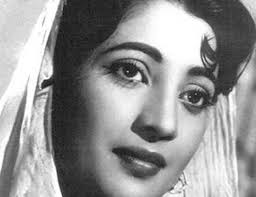
Sen was the primary Indian entertainer to get an honor at a worldwide film celebration when, at the 1963 Moscow International Film Festival, she won the Silver Prize for Best Actress for playing a disappointed alcoholic in Saptapadi. In 1972, she was granted the Padma Shri, one of the most noteworthy regular citizen grants in India. From 1979 on, she withdrew from open life and avoided all types of open contact; for this she is frequently contrasted with Greta Garbo. In 2005, she declined the Dadasaheb Phalke Award, the most noteworthy realistic honor in India, to avoid the open eye. In 2012, she was given the West Bengal Government’s most elevated respect: Banga Bibhushan.
Individual life and training
Suchitra Sen ( সুচিত্রা সেন ) was conceived in Sen Bhanga Bari town of Belkuchi Upazila, presently in Sirajgonj District, Greater Pabna in the present day Pabna District of Bangladesh, on 6 April 1931. Her dad Late Karunamoy Dasgupta was the superintendent of the neighborhood school and her mom Late Indira Devi was a homemaker. She was their fifth kid and third little girl. Ms Sen is a Grand Daughter of Famous Poet Sree Rajonikant Sen. She got her proper training in Pabna. Parcel carried her family and her to West Bengal, where she wedded Dibanath Sen, child of affluent industrialist Adinath Sen, in 1947, and had one little girl, Moon Sen, who is a previous entertainer. Her dad in-law, Adinath Sen, was strong of her acting vocation in films after her marriage. Her industrialist spouse put a ton in her vocation at first and upheld her in every potential manners.
Sen had made an effective passage into Bengali movies in 1952, and afterward a less fruitful progress into the Hindi film industry. As per industrious however unverified reports in the Bengali press, her marriage was stressed by her achievement in the film business .
Profession
Suchitra Sen made her introduction in films with Shesh Kothaay in 1952, yet it was never discharged. The next year saw her demonstration inverse Uttam Kumar in Sharey Chuattor, a film by Nirmal Dey. It was a film industry hit and is associated with propelling Uttam-Suchitra as a main pair. They proceeded to turn into the symbols for Bengali dramatizations for over 20 years, ending up just about a class unto themselves. She has acted in 30 of her 60 movies with Uttam Kumar. She got a Best Actress Award designation for the film Devdas (1955), which was her first Hindi motion picture. Her Bengali melodramas and sentiments, particularly with Uttam Kumar, put her the most on the map Bengali on-screen character ever. Her blending with Bengal’s King of Hearts Uttam Kumar made great sentimental hits (Agnipariksha, Harano Sur, Saptapadi, Pathey Holo Deri, Kamal Lata, Indrani, Sabar Upore, Suryatoran, Shaare Chuattor, Sadanander Mela, Jiban Trishna, Ekti Raat, Chaawa Paawa, Shapmochan, Bipasha, Naborag, Trijama, Rajlakshmi Srikanto, Har Mana Har, Alo Amar Alo, Ora Thakey Odhare, Grihaprabesh and others) that have appreciated imperishable prevalence and are viewed, adored and respected even right up ’til the present time.
The soaring ubiquity of this sentimental pair made a benchmark that remaining parts unchallenged right up ’til the present time. No other sentimental pair in Bengali film in the consequent decades have had the option to coordinate to the enchantment made by Suchitra Sen and Uttam Kumar.
It must be referenced here that a significant part of the pair’s fame was contributed by the tunes that demonstrated them together. The group of Hemanta Kumar Mukhopadhyay, Sandhya Mukhopadhyay, Geeta Dutt was an exceptionally effective mix that acquired tune and sentiment the ideal couple of acting that was depicted in the Uttam Suchitra motion pictures so easily. Melodies like Ei poth jodi na sesh hoye from Saptapadi, Tumi je amar from Harano Sur exhibit their easy science with one another, deifying them in the hearts of their fans.
Her movies went through the 1960s and ’70s. She kept on acting in movies even after her significant other passed on in 1970 in Baltimore, Maryland, USA, for example, in the Hindi film Aandhi (1974). Aandhi was propelled by India’s Prime Minister Indira Gandhi. Sen got a Filmfare Award assignment as Best Actress, while Sanjeev Kumar, who assumed the job of her significant other, won the Filmfare as Best Actor.
One of her best realized exhibitions was in Deep Jwele Jaai (1959). She played in a character name Radha Mitra, a medical clinic attendant utilized by a dynamic specialist, Pahadi Sanyal, who is relied upon to build up an individual association with male patients as a major aspect of their treatment. Sanyal analyze the legend, Basanta Choudhury, as having an uncertain Oedipal difficulty. He arranges Radha to assume the job however she is reluctant as in a comparative case she had become hopelessly enamored with the patient. She at long last concurs and endures to Choudhury’s brutality, imitates his mom, sings his idyllic organizations and in the process experiences passionate feelings once more. At last, even as she realizes his fix, she endures a mental meltdown. The film is noted for its mostly lit close-ups of Sen, which set the pace of the film. Asit Sen revamped the film in Hindi as Khamoshi (1969) with Waheeda Rehman in the Suchitra Sen job.
Suchitra Sen’s other milestone film with Asit Sen was Uttar Falguni (1963). She assumes the double job of a prostitute, Pannabai, and her little girl Suparna, a legal counselor. Pundits note that she brought a lot of balance, elegance and respect to the job of a fallen lady resolved to see her little girl experience childhood in a decent, clean condition.
Suchitra Sen’s worldwide achievement came in 1963, when she won the best entertainer grant at the Moscow International Film Festival for the motion picture Saat Paake Bandha, turning into the primary Indian on-screen character to get a global film grant.
There is a scene in Saat Paake Bandha where Suchitra Sen needs to tear the vest that Soumitra is wearing. Afterward, at a gathering tossed to praise the film’s prosperity, she did a rehash of the scene and tore Soumitra’s shirt, a lot to the surprise of those present. Something that nobody yet her, could have even envisioned doing in that age!
A film pundit summarized Suchitra Sen’s vocation and proceeding with heritage as “one portion of one of Indian film’s most mainstream and withstanding screen sets, Suchitra Sen reclassified fame such that not many on-screen characters have done, consolidating downplayed sensuality, female appeal and emotive power and a straightforward gravitas to cut out a persona that has never been coordinated, not to mention outperformed in Indian film”
Passing
Suchitra Sen was admitted to the emergency clinic on 24 December 2013 and was determined to have a lung disease. She was accounted for to have been recuperating admirably in the principal seven day stretch of January. She passed on at 8.25 am on 17 January 2014, because of a coronary failure.
Suchitra Sen’s demise was mourned by numerous pioneers, including the President of India Dr. Pranab Mukherjee, the Prime Minister Dr. Manmohan Singh, the Prime Minister of Bangladesh, Sheik Hasina, and B.J.P’s. Prime Ministerial applicant Narendra Modi. A firearm salute was given before her incineration, upon the sets of Mamata Banerjee, the Chief Minister of West Bengal.
Regarding her wild want for complete security, her last customs were performed at Kolkata’s Kaioratola crematorium, scarcely five and half hours after she kicked the bucket, with her pine box arriving at the crematorium in a bloom decked funeral car with dim tinted windows. In spite of being Bengal’s most prominent star, alluded to as “Mahanayika”, she had intentionally chosen to step into obscurity and she stayed a conundrum till her last, albeit a great many fans had combined at the crematorium to get one final look at their object of worship. Her whole medicinal treatment had additionally been done in withdrawal and mystery.
 Site Title