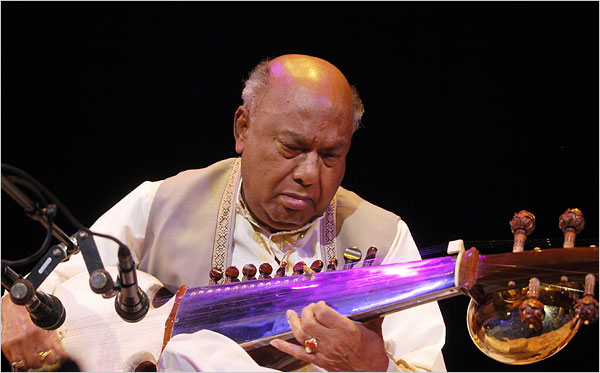
The child of persuasive Hindustani artist Allaudin Khan, Ali Akbar Khan ( আলী আকবর খান ) was one of the Eastern world’s most noteworthy artists. An ace of the sarod, a 25-stringed, lute-like, Indian instrument, Khan carried the Northern Indian old style music to the global stage. A five-time Grammy chosen one, Khan was called, by Yehudi Menuhin, “a flat out virtuoso, the best performer on the planet.” Tracing his familial roots to Mian Tansen, a sixteenth century artist in the court of Emperor Akbar, Khan started examining music at three years old. At first considering vocal music with his dad, he contemplated drums with his uncle, Fakir Aftabuddin. In spite of the fact that he had a go at playing a wide assortment of instruments, he felt most agreeable on the sarod. Preparing and rehearsing 18 hours per day, he gradually aced the instrument. In 1936, he made his open introduction during a show in Allahabad. In the mid ’40s, Khan turned into a court performer for the Maharaja of Judhpur. He before long obtained the title “Ustad” (ace performer).
In 1955, Khan acknowledged a greeting from Menuhin to perform in the United States. Notwithstanding performing at the Museum of Modern Art in New York, he recorded the main Western collection of Indian old style music and turned into the principal Indian music on an American TV when he showed up on Alistair Cooke’s Omnibus. In 1971, Khan performed with his brother by marriage, Ravi Shankar, during George Harrison’s Concert for Bangladesh at Madison Square Garden. Khan got various honors including the President of India Award in 1963, the Padma Vibhusan in 1988, the Bill Graham Lifetime Achievement grant in 1993, and the Asian Paints Shiromani Hall of Fame Award in 1997. He got the Kalidas Sanman from the Madya Pradesh Academy of Music And Fine Arts and turned into the principal Indian artist to be granted a MacArthur Foundation “Virtuoso Grant” in 1991. Khan got a National Heritage Fellowship from the National Endowment of the Arts in 1997.
In 1956, Khan established the Ali Akbar Khan College of Music in Calcutta. Educating in the United States since 1965, he opened the Ali Akbar College of Music in Berkeley, CA, after two years. (In 1968, the school moved to another site in San Rafael.) Khan showed six classes per week for nine months every year. In the mid ’90s, the school opened branches in Fremont, CA, and Basel, Switzerland. The long rundown of movies highlighting Khan’s music incorporates Chetan Anand’s Aandhiyan, Satyajit Ray’s Devi, and Bernardo Bertolucci’s Little Buddha. He got a Best Musician of the Year grant for his soundtrack for the film Khudita Pashan.
 Site Title