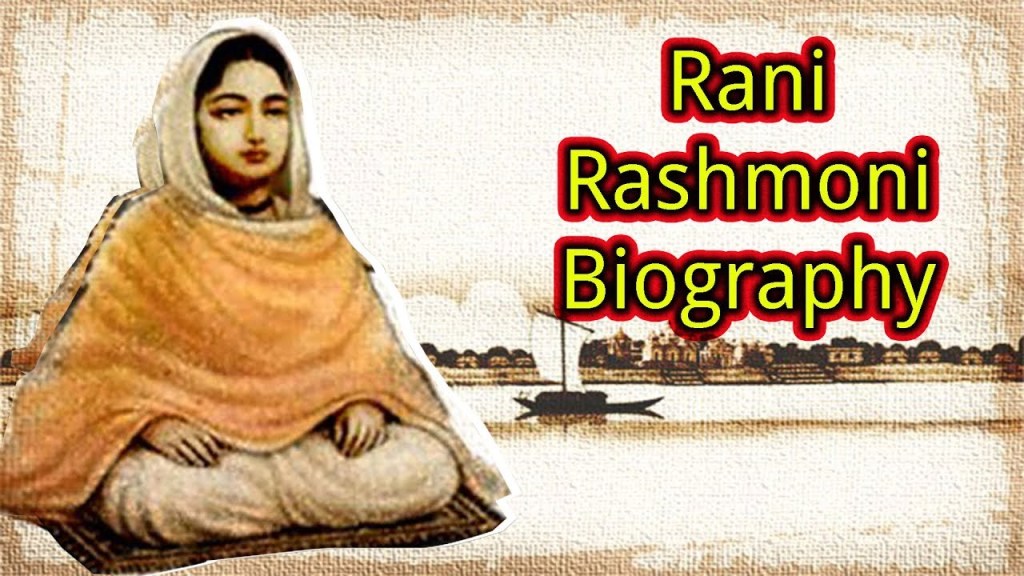
Rani Rashmoni (28 September 1793 – 19 February 1861) was the organizer of the Dakshineswar Kali Temple, Kolkata, and remained intently connected with Sri Ramakrishna Paramhansa after she named him as the cleric of the sanctuary. Her other development works incorporate the development of a street from Subarnarekha River to Puri for the explorers, Babughat (otherwise called Babu Rajchandra Das Ghat), Ahiritola Ghat and Nimtola Ghat for the regular bathers at the Ganges. She additionally offered impressive philanthropy to the Imperial Library (presently the National Library of India), the Hindu College (presently Presidency University).
By and by, the Lokamata Rani Rashmoni ( রাণী রাসমণি ) Mission is arranged at Nimpith, South 24 Parganas, West Bengal, 743338, India.
Life story
She was conceived on 28 September 1793. Her dad Harekrishna Das lived in Kona town, in present-day Halisahar, North 24 Parganas. Her mom Rampriya devi passed on when she was only seven years of age. Especially wonderful, she was hitched to Babu Rajachandra Das (Marh) of Janbazar, Kolkata, an individual from a rich zamindar family, when she was eleven years of age. After her significant other’s demise in 1836 she assumed responsibility for the zamindari and finances.She was 43 years in age at that time.They had four little girls Padmamani, Kumari, Karunamoyee and Jagadamba. Karunamoyee kicked the bucket in 1833 after labor while Kumari passed on in 1837. Padmamani was hitched to Ramchandra Ata. Kumari was hitched to Pairimohan Biswas. Karunamoyee was at first hitched to Mathurmohan Biswas. After her demise Jagadamba was offered to him.
She started taking care of the zamindari after her better half’s demise.
The Rani and her conflicts with the British in India became family unit stories in her time. By hindering the transportation exchange on a piece of Ganges she constrained the British to annul the expense forced on angling in the stream, which undermined the job of poor anglers. When Puja parades were halted by the British on the charge that they upset the harmony, she opposed the requests. The British needed to pull back the punishment forced on her even with open resistance and revolting in her help. Rani Rashmoni likewise had surprisingly various beneficent works and different commitments to society. She managed the development of a street from Subarnarekha waterway to Puri for explorers. She supported the development of ghats, for example, Babughat (in memory of her better half), Ahiritola Ghat and Nimtala Ghat for the every day bathers in the Ganges. She gave liberally to the then Imperial Library (presently the National Library of India) and Hindu College (presently Presidency College). Ruler Dwarkanath Tagore had sold a piece of his Zamindari in now South 24 Parganas (some portion of present-day Santoshpur and bordering territories) to Rani Rashmoni for his section to England. This piece of land which was then a piece of the Sunderbans was muddy and practically appalling aside from certain groups of hooligans who found the territory helpful to remain and wander out for loots in far away places mounted on stilts. Rani Rashmoni convinced these families and helped them to develop fisheries in the encompassing water bodies that later transformed into enormous rich bheris. They continuously surrendered their ‘calling’ of pillaging and changed into a network of anglers. This was an extraordinary social change that the Rani had started.
A celestial disclosure drove her to establish the popular sanctuary Dakshineswar Kali Temple complex on the banks of the Ganges at Dakshineswar in the North 24 Parganas. Sri Ramakrishna Paramhansa (at that point known as Gadadhar) was delegated its head minister under her support.
Despite the fact that having such an incredible profound nature the general public at that point had separated her. Being conceived in Kaivarta family ( Mahishyas ) and being a center standing Shudra cause, no Brahmin was prepared to be the cleric in her sanctuary.
Rani Rashmoni’s House at Janbazar was setting of customary Durga Puja festivity every harvest time. This included conventional ceremony, including throughout the night jatras (society theater), as opposed to by diversion for the Englishmen with whom she carried on a running quarrel. After her passing in 1861, her children in-law took to observing Durga Puja in their separate premises
In mainstream culture
Rani Rashmoni has additionally been subject of an anecdotal movie in Bengali language, titled Rani Rasmani (movie) (1955), coordinated by Kaliprasad Ghosh, and wherein lead played by acclaimed theater character and on-screen character Molina Devi.
Zee Bangla includes a day by day cleanser delineating the life of the renowned Rani, inscribed Karunamoyee Rani Rashmoni which debuted on 24 July 2017 and is broadcasted day by day.
Landmarks
A road in Esplanade, Kolkata is named after her as Rani Rashmoni Avenue, where her statue is additionally found.
Further, a street is named after her as Rani Rashmoni Road close to her familial house at Janbazar, Kolkata.
Additionally a street is named after her as Rani Rashmoni Road at Dakshineshwar.
The Department of Post of Government of India gave a postage stamp to memorialize the bicentennial of Rani Rashmoni in 1993.
A Ferry Ghat known as Rani Rashmoni Ghat has been worked for ship benefits in Barrackpore, West Bengal and in Hooghly, West Bengal (soon after the Hooghly District Correctional Home).
One of the 5 Fast Patrol Vessels of Indian Coast Guard has been named after Rani Rashmoni. It was appointed in June 2018 and will be situated in Visakhapatnam
 Site Title